

Innovation
Remynd secures €3.5 million investment from the Alzheimer's Drug Discovery Foundation to take its first-in-class septin modulator into Alzheimer's patients
At this year’s Innovation for Health, held on 26 March at Jaarbeurs Utrecht, ten young researchers and innovators presented innovative healthcare solutions and competed for the I4H Young Innovator Award, powered by Genmab. After a series of live pitches on the BiotechNews stage, the jury composed of Liana Steeghs (Genmab), Nettie Buitelaar (Biotech Booster) and Laura Heitman (FIGON) selected Tim Sakkers, an entrepreneurial postdoctoral researcher from UMC Utrecht, as winner of the I4H Young Innovator Award 2026.
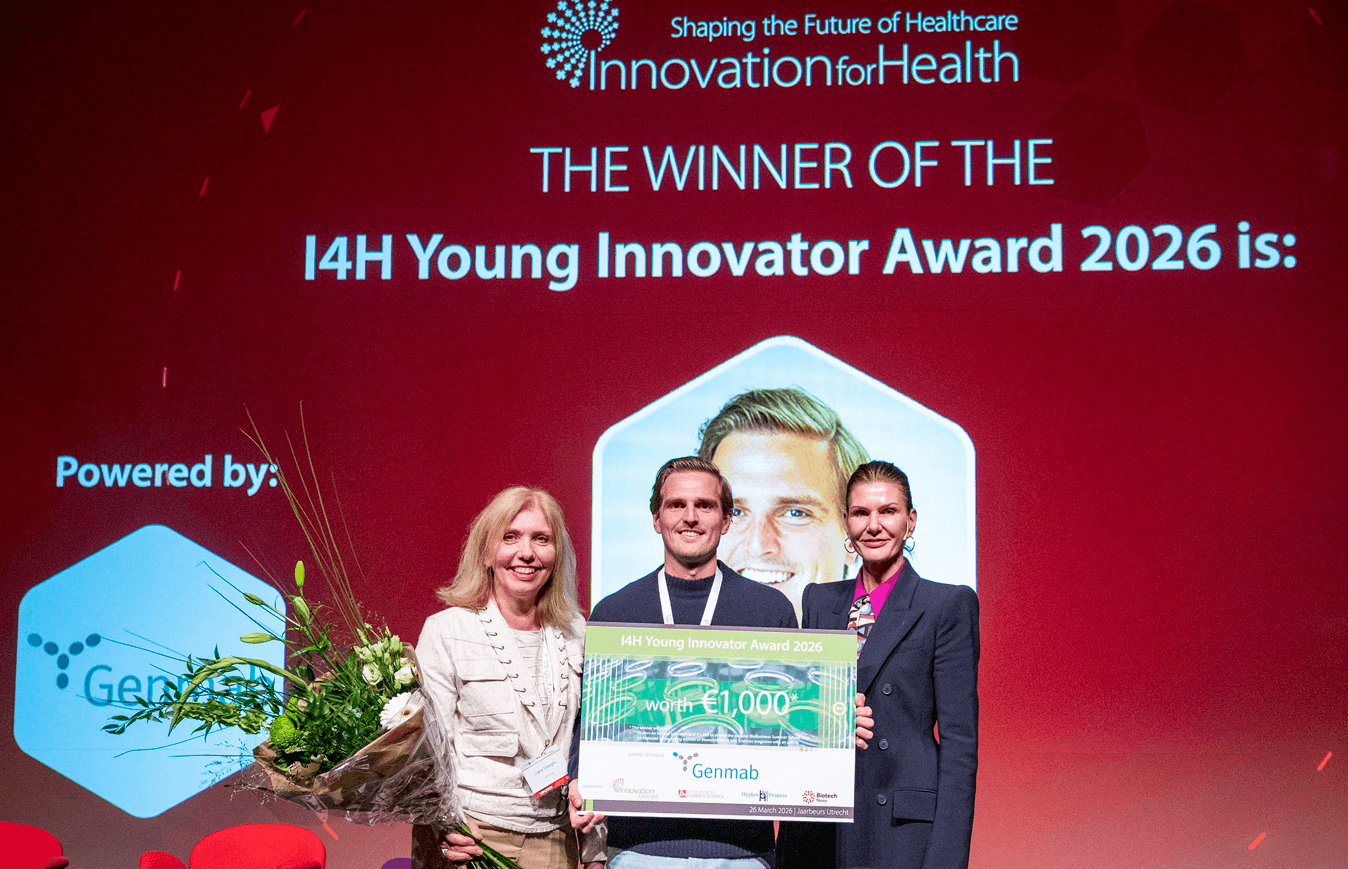
Photo FLTR: Liana Steeghs, Tim Sakkers, Martine van Vugt Photo by:
Sakkers received the award from Martine van Vugt, Executive VP and Chief Strategy Officer, Genmab, for his presentation, ReveltaDx – Transforming Heart Disease Diagnosis in Women, in which he introduced a novel blood-based diagnostic approach for Angina with No Obstructive Coronary Arteries (ANOCA), a frequently overlooked cardiovascular disorder that disproportionately affects women.
A hidden cardiovascular disease affecting millions of women
Although heart disease remains the leading cause of death worldwide, many patients with persistent chest pain still leave hospitals without a clear diagnosis. In up to 50% of patients presenting with ischemic symptoms, no obstructive coronary artery disease is found. A large proportion of these patients are now classified as having ANOCA.
The condition affects an estimated three to four million people in the United States, with similar prevalence expected across Europe. Women represent the vast majority of diagnosed cases: among patients referred for definitive ANOCA testing, around 90% are diagnosed with the disease, and approximately 90% are female.
For decades, many women with ANOCA symptoms were told their complaints were stress-related, hormone-related, or unrelated to heart disease. Yet the condition is increasingly recognised in current European Society of Cardiology guidelines as a serious cardiovascular disorder requiring dedicated diagnostics and treatment.
From invasive catheterisation to a simple blood draw
Unlike classic coronary artery disease caused by arterial blockages, ANOCA results from dysfunction in the coronary microvasculature or abnormal vessel spasms. These mechanisms are invisible on standard imaging and can currently only be diagnosed through coronary function testing, an invasive catheter-based procedure available in limited specialised centres.
Sakkers’ innovation, developed under the name ReveltaDx, aims to replace that pathway with the first minimally invasive blood-based test for ANOCA.
The platform combines targeted sequencing with artificial intelligence to identify disease-specific molecular signatures in blood and determine the underlying pathology behind a patient’s symptoms.
This could shorten the diagnostic journey from as long as four years to less than two weeks, while avoiding invasive procedures and inconclusive repeat imaging.
Major cost reduction and faster treatment decisions
The economic impact could also be substantial. Current ANOCA diagnostic pathways often involve repeated consultations, hospital admissions, imaging procedures, and invasive catheterisation, with costs reaching up to €35,000 per patient.
ReveltaDx aims to reduce those costs to approximately €500 per patient through scalable molecular diagnostics.
Earlier diagnosis could also improve long-term outcomes by enabling timely treatment and reducing progression to complications such as heart failure.
Translating academic science into clinical innovation
The project is led by Sakkers together with Dr. Ernest Diez Benavente as Lead Developer, while Prof. Hester den Ruijter serves as Scientific Advisor.
According to the jury, ReveltaDx stood out for combining scientific originality, a clear unmet medical need, and a realistic route toward implementation in healthcare systems.
The award signals growing momentum for innovations that specifically address historical blind spots in women’s cardiovascular health — an area increasingly recognised as one of medicine’s most urgent unmet needs.
Young innovators aiming to present their innovation with a pitch and a poster can take the stage at the next edition of Innovation for Health on 11 March 2027 in Utrecht.


