
Industry
Quantum sensing maakt zichtbaar wat cellen normaal verborgen houden
With internationally recognised cancer centres, a strong academic base, and a growing early stage biotech landscape, the Netherlands is well positioned to lead in the delivery of next generation cancer therapies. Yet despite this scientific strength, promising discoveries take long to reach patients.
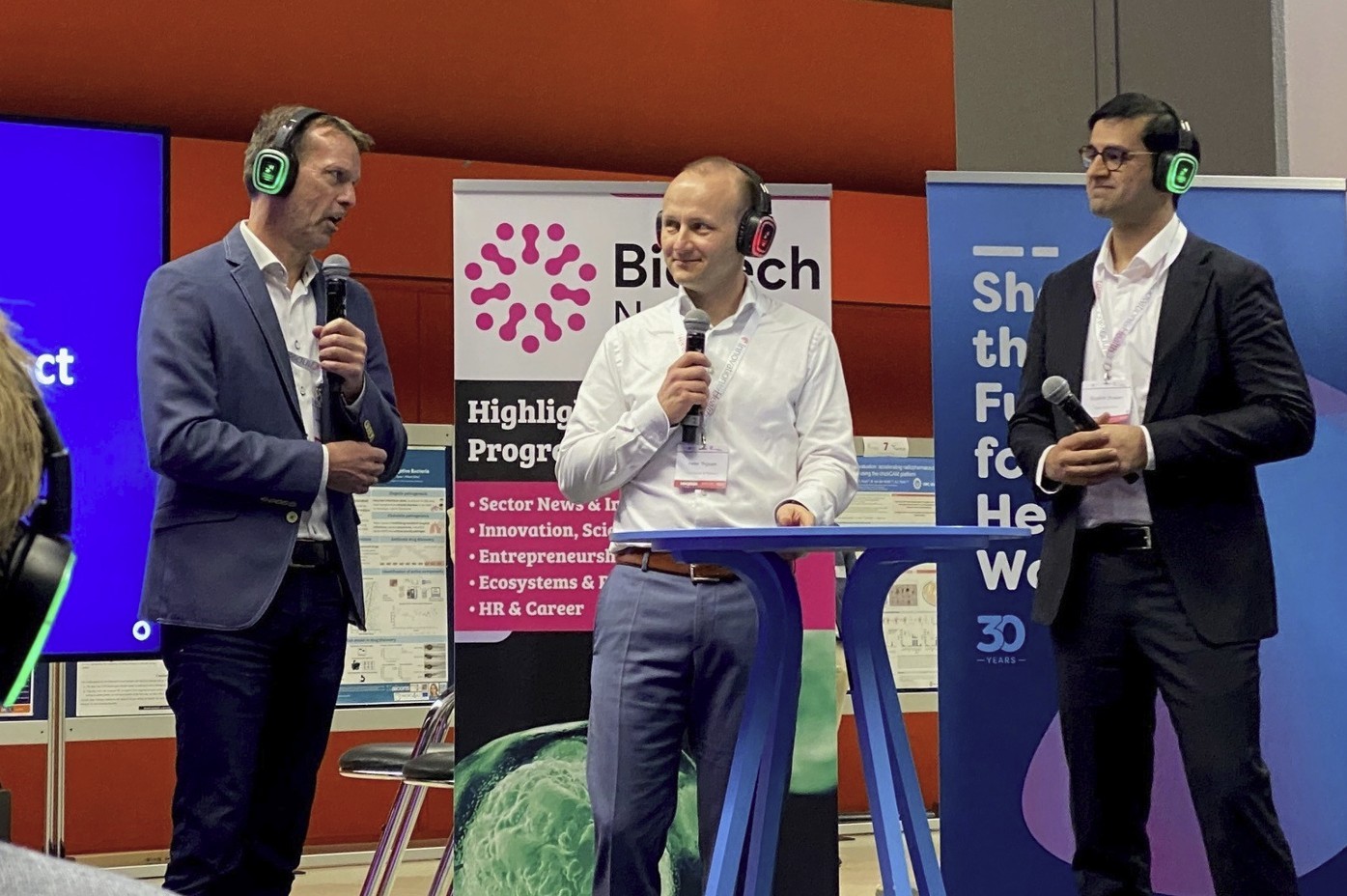
That disconnect—the persistent gap between excellent oncology science and impact on patients’ lives—was the central theme of a recent conversation between Shobhit Dhawan (Oncode Bridge Fund, Ligase BioPartners) and Bertholt Leeftink (Oncode Institute, Oncode Accelerator) during a live, on-stage interview with BiotechNews.
Their shared message was optimistic: the Netherlands has everything required to lead in oncology innovation – but we should smoothen the pathway from discovery to clinic. With the launch of the second Oncode Bridge Fund, they hope to help in closing that gap.
Strong science, weak translation
The problem is not the science. That’s one thing Dhawan and Leeftink can quickly agree on. In fact, Dutch oncology research is among the strongest in Europe.
“We have excellent research groups, incredible scientific output, and a highly collaborative community”, says Leeftink, “but translating that into patient benefit remains too slow. We refer to it as the knowledge paradox: scientific insights do not reach patients well enough.”
Dhawan agrees, noting that oncology is uniquely well positioned to bridge this gap. “Oncology is the one field where we have the models, the tools, the data, the organoids—everything needed to move quickly. We have no excuse for not translating our knowledge into the clinic.”
Take an example of our neighbours
There are ecosystems close to home as good examples of how to make true on the promise of scientific advancement. In Belgium, the UK, and even the Dutch high‑tech sector long‑term continuity prevails over short‑term funding cycles as the foundation of success. “Those ecosystems didn’t emerge overnight,” Dhawan says. “They were built over 20 or 30 years with stable policy, public co-investment, and long-term vision.” Leeftink adds that long-term industry–university collaborations, common in engineering and chip technology, should become standard in life sciences as well. “We don’t need to copy others. But we do need to adopt that mindset.”
“We should commit to funding instruments that work,” Dhawan points out, “and stick with them long enough for the results to show. Instead of creating a new instrument every four years, underfunding it, and giving it a short runway that cannot produce meaningful results.”
Keeping innovation in the Netherlands
One of the key bottlenecks for innovation to reach patients is early-stage financing. That’s why Leeftink and Dhawan are excited about launching the second Oncology Bridge Fund, as a collaboration between Oncode Institute and Ligase BioPartners. At the same time, they see the need for larger seed capital to become available in the Netherlands.
Dhawan: “We need both – one can’t go without the other. Pre‑seed funding - for example through the Oncology Bridge Fund - has a clear role: it reduces risk, keeps innovation local, and helps promising ideas grow into viable ventures.” At the same time, we do need sufficient seed capital. “Without reliable seed capital, young scientific ventures often move abroad—taking knowledge, IP, and economic value with them,” Leeftink adds, “A national, dedicated seed fund would be necessary to provide sufficient capital.”
Short-term political cycles affect long-term biotech investments, however. When funds must show quick returns, they shift away from early, high‑impact innovation. “Early‑stage biotech invests on timelines of 12–15 years, while our political system operates in four‑year bursts,” says Dhawan. “It would be great if the Netherlands can close this gap.”
Closing the gap for pre-seed funding
The newly launched second Oncology Bridge Fund can play a pivotal role in stimulating early-stage oncology innovation. The first fund, launched in 2019, shows that the model works. Since its inception, roughly 15 spinouts were supported, and multiple innovations were developed towards the clinical. The new fund aims to scale that success—backing ventures at their earliest and riskiest stage.
For Dhawan and Leeftink the message is simple: innovation only matters if patients feel the impact. The Netherlands has the science. Now it needs the commitment and consistency to let that science become therapies that can help cancer patients.


