
Career
Employeneurship: TMC's Model for building lasting careers in Life Sciences
What does it take to close the gender gap in life sciences leadership? This was the central question at the TOPX session on Bridging the Gender Gap at Innovation for Health 2026. From surprising cultural observations to hard data from the Nordic WiLD survey, this report uncovers why talent alone is not enough to reach the top — and why mentorship, transparency, and leadership accountability are essential to create lasting change.
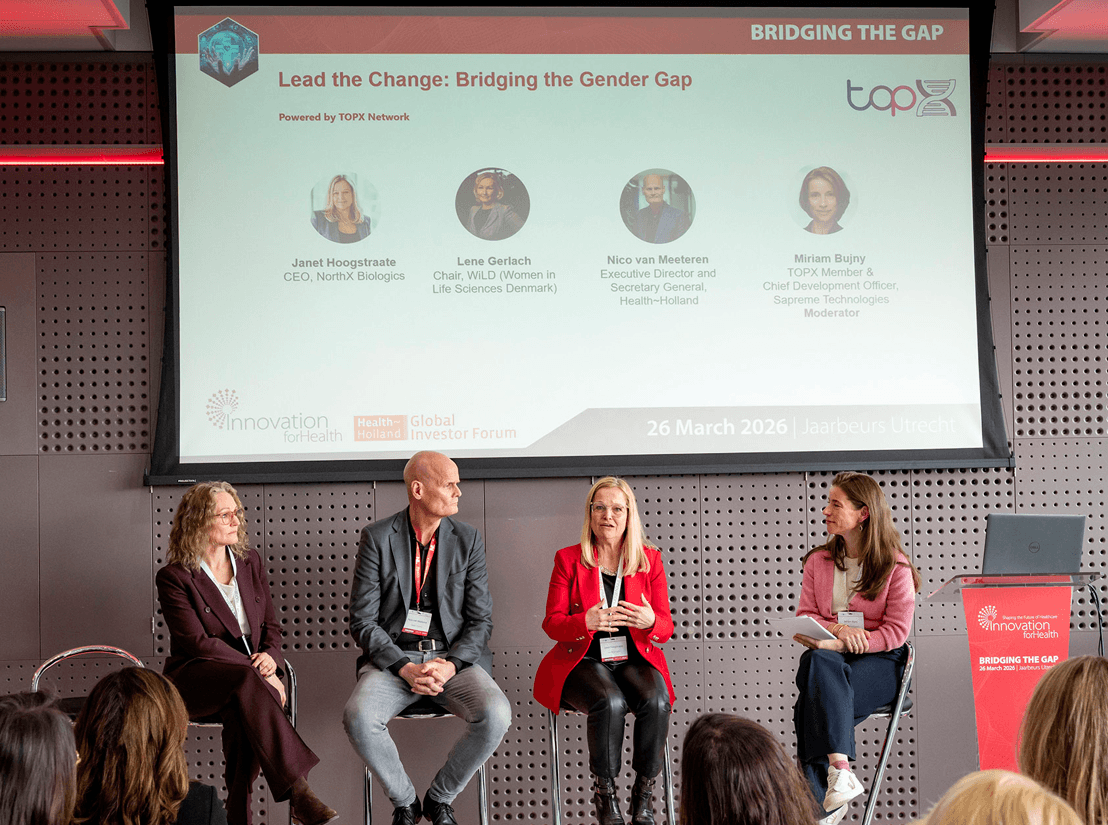
Powered by TOPX Network at Innovation for Health 2026 - reported by Lidia Daszkiewicz (CSO, Thala Therapeutics)
Nothing. They’re not nannies - they’re dads on paternity leave, out in the park with their children.
Tech and AI futurists often say: “The future is already here - it’s just not evenly distributed.” Paraphrasing and adapting it to our topic, I say:
“The mindset is already here - it’s just not evenly distributed.”
This question about “nannies” was asked by a colleague to a female leader returning from maternity leave in Sweden. It perfectly illustrates how far apart perspectives still are. On one hand, society has shifted - long paternity leaves are normal in many Nordic countries. On the other hand, old assumptions persist: many still believe it should be the mother who pauses her professional life for childcare. To add to this, the pay gap between men and women has increased in Denmark over the past few years!
During a very energetic session powered by TOPX, we learned the key findings from the Nordic WiLD Survey and White Paper addressing challenges and opportunities for women across the sector. WiLD (Women in Life Sciences Denmark), represented by chair Lene Gerlach, surveyed 212 women already in leadership roles, reflecting on their journeys with the ambition to extract learnings for the next generation - still vastly underrepresented at the top (only ~20% in DK).
The survey clearly contrasted career enablers and blockers and identified their origin points. A central insight emerged: “The challenge is not a lack of qualified women, but how leadership and power structures operate at senior levels.”
Most Nordic female leaders experienced both enablers and blockers - interestingly, often stemming from the same source: their closest leaders and top management. Men were disproportionately identified as sources of barriers. This is not surprising: those closest to us in the hierarchy shape our career trajectory the most. Ultimately, power - and who holds it - shapes outcomes. Always.
A lively debate followed on the question of who “owns this problem,” or as panellist Nico van Meeteren (Health~Holland) called it, this “strategically relevant issue.” Who should drive the change - top or bottom? Thanks to excellent moderation by Miriam Bujny (Chief Development Officer, Sapreme Technologies), the passionate exchange arrived at a shared conclusion:
“Top needs to meet bottom.”
Panelist Janet Hoogstraate (CEO, NorthX Biologics) made an especially important point: women often believe they are not ready when invited to join top roles or boards. A powerful message to those already in leadership: mentor other women to say “yes” the first time around.
And if you are a man who is aware of these dynamics and genuinely cares about progress - like Nico - then mentor other men. Only by leading by example and working together can we truly influence change.
But in addition to mentorship, we need data. Without data - as the saying goes - you’re just another person with an opinion. However, it turns out people also have strong opinions about the data itself, its validity, and its reflection of reality. The audience challenged whether the WiLD survey should also have included men. It may well have led to similar insights - because climbing the ladder is tough for everyone. It requires resilience, grit, and perseverance; competition stiffens, and leadership becomes lonely at the top. We should go deeper into the data and address this “strategically relevant issue” from a broader diversity perspective - not just gender, but also age, background, and more.
And remember: data only becomes useful when you can mine it and turn it into insight.
This is exactly what happened with the WiLD survey. Key recommendations emerged:
· Make leadership pathways transparent: Establish clear, visible criteria for promotion, succession, and leadership roles to reduce reliance on informal networks.
· Formalise sponsorship at senior levels: Make it an explicit responsibility for senior leaders to sponsor and advance high‑potential talent into strategic roles.
· Open access to decision‑making arenas: Ensure broader and more structured access to boards, strategic projects, and capital‑allocation forums.
· Increase transparency in board and recruitment processes: Move beyond closed networks by using structured, independent nomination and hiring procedures.
· Track and act on leadership data: Systematically measure representation, promotion, compensation, and access to strategic roles — and link outcomes to leadership accountability.
The full survey results will be published in April - connect with Lene Gerlach on LinkedIn to receive the link.
As for me: stay optimistic. Even if some current trends (like the Danish pay gap) are moving in the wrong direction, the overall trajectory is positive. More leaders are genuinely engaged in the dialogue - and more dads are pushing strollers in the park 😉.
PS. Written by a human - AI only corrected my typos.


