Opinion
Life sciences is the fastest-transforming industry on earth right now. And women are being left out of the rooms where it's being decided
5 min read
The life sciences sector is undergoing a period of disruption unlike anything in its recent history — AI at scale, a $240 billion M&A surge, precision medicine, and a looming patent cliff that puts $370 billion in revenue at risk by 2032. This transformation is creating an urgent need for a new kind of leadership. Women in life sciences have never been more qualified to fill it. And most of them are still being blocked from the opportunity to try.

By: MIRA VASIC, Ph.D., Female Leadership Expert, Keynote Speaker, LinkedIn Top Voice
At the JP Morgan Healthcare Conference in April 2025 — the most influential gathering in the life sciences calendar — there were more men in the room named Michael than there were women CEOs.
This is not a historical footnote. This happened last year, in an industry where women make up 56% of the workforce.
The industry is in the middle of the biggest transformation in its history. The decisions being made right now — about AI, about M&A, about where the next billion in R&D investment goes — will shape medicine for the next two decades. And the people making those decisions are overwhelmingly men.
That needs to change. And change does not happen by waiting for the industry to fix itself.
The numbers that should make every life sciences executive uncomfortable
Life sciences is exceptional among industries in one regard: women make up 56% of the life sciences workforce — a majority, not a minority. And yet at the top, the picture looks nothing like that majority.

In medtech, women held 26.5% of leadership roles in 2025 — up from 24.4% in 2024. At this rate of two percentage points per year, medtech won't reach gender parity in leadership until we're nearing the 2040s.
Between November 2024 and February 2025, not a single biotech that launched or raised Series A funds was headed by a woman. Not one. In an industry where women are the majority.
This is not a pipeline problem. Women are in the industry. They are qualified, experienced, and ambitious. The problem is what happens to them between the lab bench and the boardroom — and the question of who is preparing them to navigate it.
"Women enter life sciences at the same rate as men. The question is what happens to them between the lab bench and the boardroom."
Why this moment is different — and why it matters more than ever
The life sciences industry is not just growing — it is being fundamentally restructured. Understanding what is driving that restructuring helps explain why the leadership gap is about to become more consequential, not less.
AI is moving from pilot to scale. Nearly half of life sciences executives identified accelerated digital transformation as a trend that will have substantial impact on their organisations in 2026. The proliferation of generative AI was cited by 41% as influential, while 30% cited agentic AI — systems that can act autonomously to make decisions and perform tasks. The organisations that will win this transition are those with leaders who can direct AI strategy, manage human-AI collaboration, and build the trust that makes adoption work.
M&A is surging and integration is the hard part. Life sciences M&A hit $240 billion in 2025 — with deal sizes more than doubling, averaging $2.1 billion. 45% of biopharma leaders and 51% of medtech leaders identify M&A as a priority. Post-merger integration is where most deals fail or succeed. It is also where collaborative, relationally intelligent leadership is the decisive variable.
The talent constraint is the binding limit on growth. Many organisations are struggling to recruit for capabilities tied to digital transformation and modern therapeutic platforms. Women are 1.5 times more likely to move to a company committed to diversity, equity and inclusion initiatives, and 88% consider diversity an essential factor when considering new employment. Organisations that cannot retain senior women will lose the talent war in a market where talent is already the constraint.
WHAT THE DATA SAYS ABOUT WHAT ACTUALLY WORKS
Targeted leadership development programmes for women in science produce measurable advancement outcomes within 12–18 months
Cohort-based learning builds both skills and the informal networks that sustain careers long-term
Salary negotiation training closes pay gaps at the individual level while sector-wide change is still in progress
Executive visibility coaching directly addresses the informal network problem
Four barriers that keep qualified women out of life sciences leadership
The informal network problem. In life sciences, the most consequential career conversations happen informally — at conferences, over dinners, in the corridors of the JP Morgan Healthcare Conference. In 90% of scientific academies surveyed, nomination relies on existing members. In contexts where membership is already predominantly male, such procedures perpetuate existing imbalances.
The visibility gap. Women in science are systematically less likely to be invited to speak, to be quoted, to be cited, and to be nominated for recognition. Visibility compounds — those who are seen get seen more. The women who break through are often those who have deliberately built their public profile alongside their scientific credibility.
The motherhood penalty. When a woman becomes a mother, she is often seen as less committed to her career. In an industry built around long development timelines and intensive clinical phases, this penalty is felt acutely — during the years when careers accelerate or plateau.
The sponsorship deficit. Women in life sciences consistently report having mentors and lacking sponsors — people who speak up for them when they are not in the room, who put their name forward for stretch assignments, who advocate for their promotion.
What the industry needs from women leaders right now
Most executives — nearly eight out of ten — expect AI to drive real, game-changing impact by 2026. Translating scientific discovery into scalable commercial impact requires strategic thinking, stakeholder influence, cross-functional leadership, and the ability to operate effectively at the intersection of science and business. These are learnable skills. And most organisations do not invest in developing them for the women in their pipelines.
The result is a cohort of highly credentialed, deeply experienced women in life sciences who are technically equipped to lead at the highest level — and who have never been given the specific preparation that the transition to senior leadership actually requires.
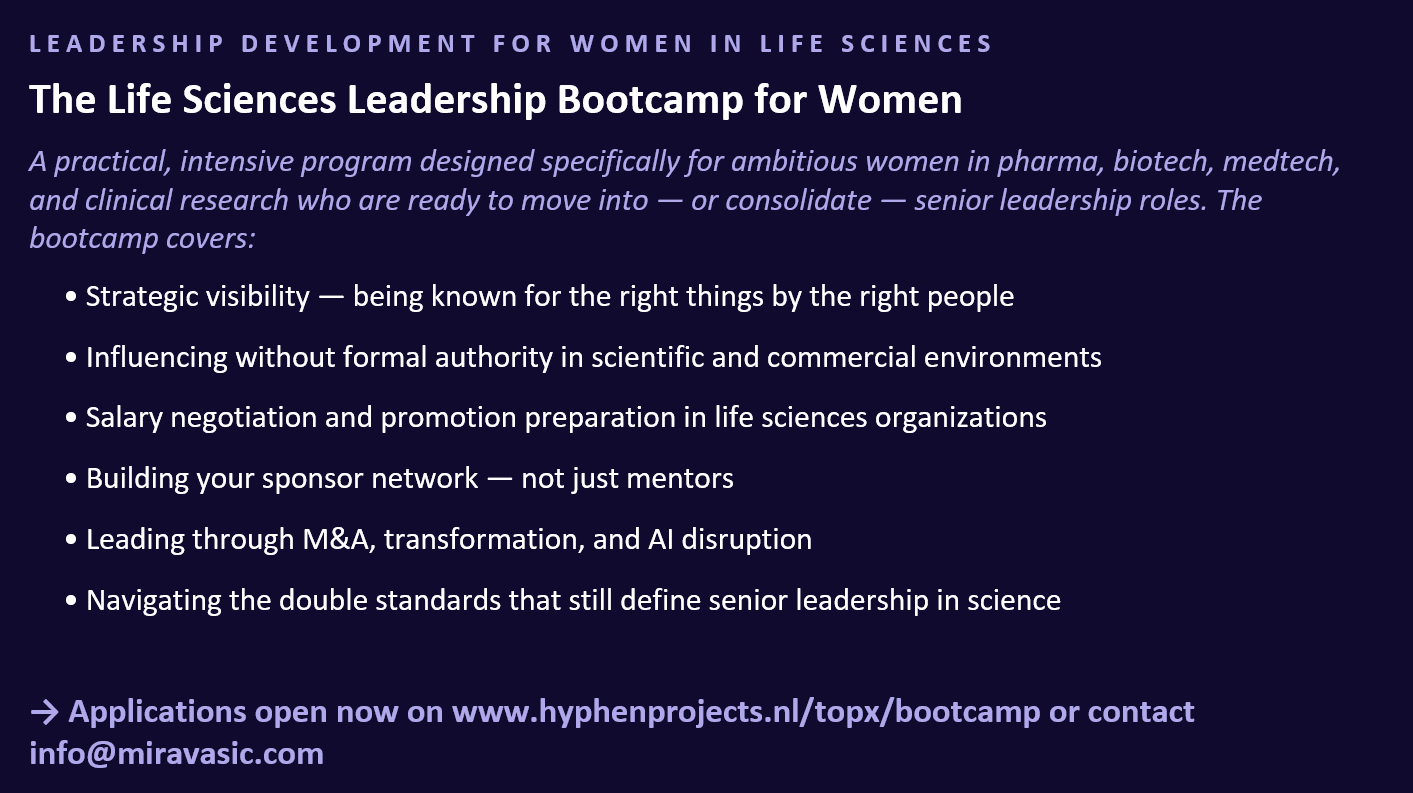
For more information about this leadership programme in collaboration with TOPX Network visit this website.