Career
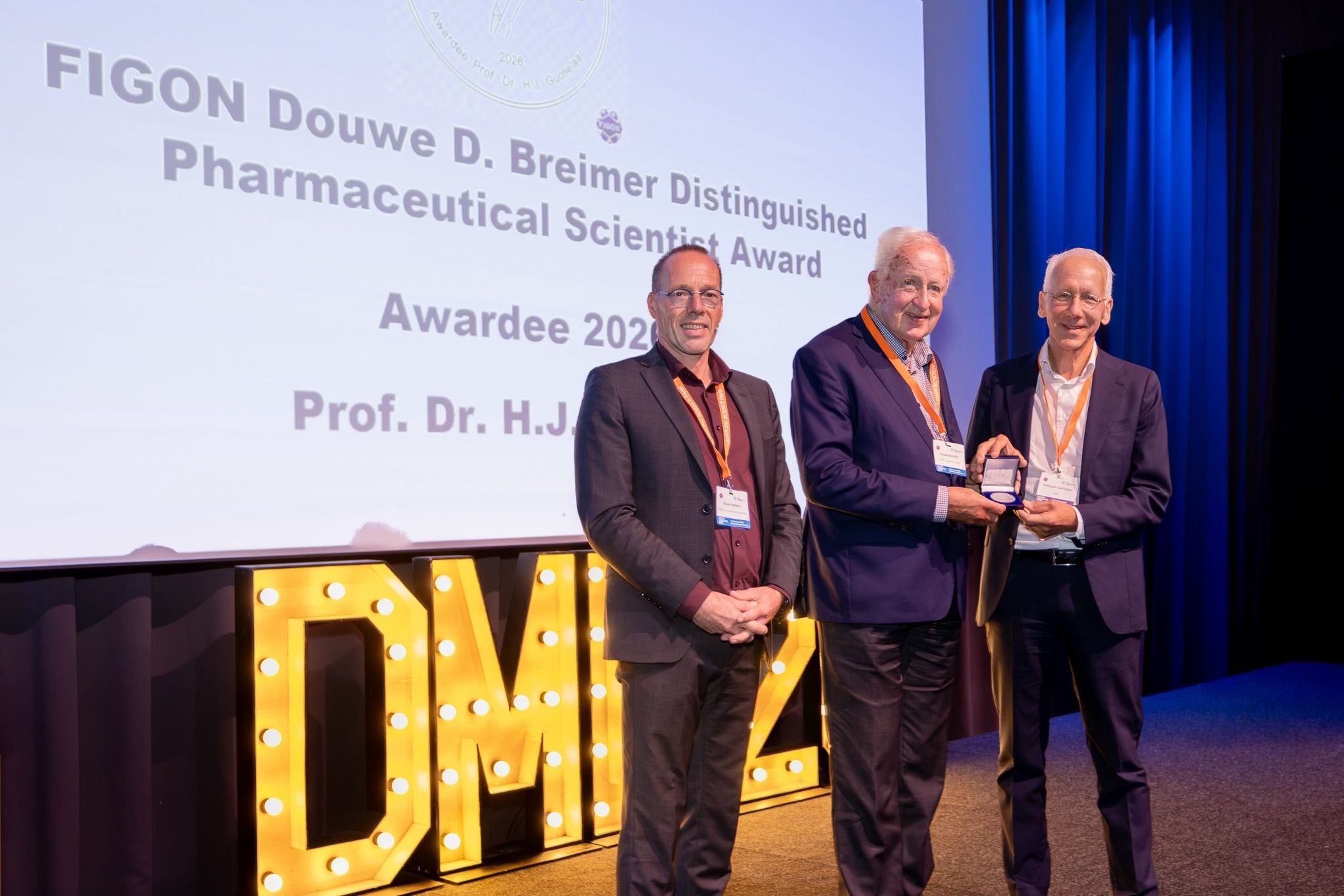
Henk-Jan Guchelaar Receives the First FIGON Douwe D. Breimer Distinguished Pharmaceutical Scientist Award
For twenty years, one question has followed Hanneke Takkenberg through her research and into the institutions where she works: what a system built for men does to the women inside it. Her career has been an attempt to answer that question – and increasingly to change the system itself.

By Jayashree Jayachandran
It started with a graph displaying the distribution of salary scales for men and women. Takkenberg was reading Erasmus MC's annual social report when she noticed the divide. Women made up most of the hospital's workforce, but men filled the highest pay scales. "There was a really big divide," she says. So she wrote to the board of directors. "A bit impulsive," she says now. "I don't do that anymore." The next day, her phone rang. It was the first woman ever appointed to the Erasmus MC board. "She said, 'Well, let's get to work.'"
Around that same time, she made another decision that would shape her career: she chose not to become a practicing surgeon. "The system at that time was simply not designed for people like me, for women," she says. She describes the surgical world as masculine and paternalistic: intensely competitive, deeply hierarchical, shaped by toxic masculinity. She could have adapted herself to succeed within it. "That did not feel right."
The realization came gradually, but it set something in motion. If she was unwilling to adapt herself to the system, she would have to help change the system instead. Alongside her research into how cardiac interventions affect women and men differently, she helped develop diversity policy at Erasmus MC, became Chief Diversity Officer at Erasmus University, and chaired the Dutch Network of Women Professors. The work eventually led to a second professorial chair at Rotterdam School of Management, where she now directs the Erasmus Centre for Women and Organisations.
The same thinking shapes how Takkenberg approaches science. For her, research is not a solitary exercise. Her projects cross disciplinary boundaries, draw on the social sciences, and involve patient advocacy groups throughout the research process. She works on several projects at once, bringing people together as the work develops. "That's a more feminine approach, which is rather new in the field that I work in," she says. "We used to work in silos and do our own thing and not bother others too much."
For years, that institutional work sat alongside her research in cardiac surgery, something she treated "more as a hobby." Then, in early 2024, a World Economic Forum report on the global gender gap in health made her see the issue differently. The report showed that women spend 25 percent more of their lives in poor health than men. Closing that gap, it estimated, could add as much as $1 trillion a year to the global economy by 2040. But for Takkenberg, the argument goes beyond the economic numbers.
Poor health can limit women's ability to work and become financially independent, leaving them more vulnerable to poverty later in life. It can also affect the people around them. Women still carry much of the caring work in families, she points out, so when women are not healthy, the consequences can extend to their children, partners and wider communities. "It's not only because of social justice, because it's fair," Takkenberg says. "There's also a very strong business case."
For her, that makes women's health one of those issues that cannot be separated from the other challenges facing society. Improving women's health means addressing economic inequality, family health and women's participation in society at the same time. It was this interconnected view that helped drive the creation of the women's health centre: bringing together people who were already working on different parts of the same problem.
In March 2025, Takkenberg co-founded the Netherlands Women's Health Research & Innovation Center at Erasmus MC with Professor Jeanine Roeters van Lennep, an internist in vascular medicine, and Greet Vink, then head of the hospital's research and development office. It is the first research and innovation center in the Netherlands devoted entirely to women's health.
They began with no formal budget. Their only initial investment was a box of pink t-shirts featuring a bold slogan: Girls just want to have funding for women’s health research & innovation.
Despite the cheeky start, the vision was highly intentional. Designating it a "Netherlands" center at Erasmus MC signaled a much larger ambition: they had no intention of operating in a silo. The ultimate goal was to spark a nationwide network of similar hubs, all grounded in complementarity, collaboration, and equity.
Securing institutional backing required persistence. Her initial pitch for a €1.5 million, five-year plan yielded just €100,000 for a one-year program manager, but it was the foothold she needed. Anchored in a mission to bridge research and clinical innovation, this modest start meant that new opportunities quickly began outpacing the initial funding.
The most significant of these is Menopause Matters, a €5 million national consortium financed through Health Holland and coordinated from Erasmus MC. The initiative unites the University of Twente, Amsterdam UMC, the investment group Borski Fund, and the women's advocacy platform Vuurvrouw to engineer technological solutions for menopause. True to Takkenberg's vision, the program serves as a bridge between academic researchers and industry innovators, ensuring that proven, effective solutions successfully reach the market.
Soon, people began reaching out on their own, offering to contribute, raise funds or help spread the word. For Takkenberg, the response showed that the mission had already reached far beyond the hospital: "So, with nothing but a box of T-shirts, you can come a long way."
Takkenberg is deliberate about the language she uses. When asked why she prefers gender equity to gender equality, Takkenberg points to the Dutch concept of gelijkwaardigheid, which comes closer to "equally valued" than simply "equal." For her, equality can move towards homogeneity: the idea that fairness means giving everyone the same opportunities. But men and women are not the same, and in a system shaped around men, those opportunities are still defined by that system. Equity, she argues, means recognising differences and commonalities and making sure everyone has a genuine opportunity to participate and succeed, even when that opportunity does not look the same for everyone.
In practice, she says, that starts with questioning hierarchy. "I don't want you to be afraid of me because of the role I have in my organisation," she says. "I want you to be free to voice your opinion, and voice your feelings, because it matters." For Takkenberg, that freedom is also essential for innovation. If people only surround themselves with those who agree with them, nothing new emerges. An equitable organisation, she argues, is one where different voices can challenge each other and where everyone has something to contribute. Gender bias, she says, is not something we can simply cure. But we can become aware of it and carry that awareness into the way we work with one another.
This is also what she hopes that the women's health centre can demonstrate. By bringing researchers and clinicians from different fields together, it breaks down the silos that have kept people working separately and creates what she calls an "inclusive ecosystem" where people can learn from one another. The aim is not to compete but to complement one another.
Across the Netherlands, she points out, there are already many institutions working on women’s health. The centre does not want to absorb them. "We'd rather connect, and have everybody join from their own strength and with their own focus."

Along the way, Takkenberg developed a number of principles that guide both her career and her approach to leadership.
Stay close to who you are. "Don't try to lean in, or to become somebody who you don't agree with."
Build your network on purpose. Carefully, thoughtfully, and with time protected for things that are important but not urgent. "The more you grow in your career, you come to the realization that everything is network."
Keep a close circle of female friends you trust. She credits hers.
Be creative and stay open to challenges. It is easy to remain where you are, particularly when family and location make moving more complicated. But sometimes the problem is not you; it is your position. There may be better opportunities elsewhere, if you allow yourself to look for them. "Allow yourself some flexibility and adventurousness," she says.
Learn to say no. "Saying no is not a selfish act. You're actually helping your organisation." The task still gets done, the distribution of tasks improves, and everyone's real strengths get used.
On work and family, she speaks candidly about the realities of balancing a career and home life. She has four daughters. The years when they were small were genuinely hard to balance, filled with missed ballet performances and late arrivals to sports days. What worked was a combination of heavy outsourcing, a clear agreement with her partner, and intentional planning. At the start of each school year, she signed up for at least one event, usually the school trip, which her children looked forward to all year. She also believes it is important to plan quality time with your partner. "There's not one way to do this," she says.
Outside work, Takkenberg makes time for volunteering, where she can use her skills as a researcher in ways that give back to society. She also spends a lot of time outdoors. Hiking is part of her routine: she walks around 10 kilometres a day and, once a year, takes on an island, covering about 50 kilometres in a single day along beaches and through nature. She has climbed Mount Fuji and still has plenty of ambitions on her list. "My great ideas always come when I'm out in nature, doing a really long walk." For her, walking is not just a way to stay active. It is where she thinks, reflects and lets ideas develop. She encourages others to find their own way of stepping away from the noise of everyday life and making space for new ideas.
What she hopes for this generation is that people allow themselves to look beyond a single point on the horizon. She hopes that women and men feel free to take a long and winding road, even if the destination turns out to be different from what they imagine now. For Takkenberg, life is a journey best lived by staying in the here and now, cherishing the people around you and enjoying the networks you build, both professionally and personally. "If you're stuck in your room trying to get your experiments perfect, it's not going to bring you anywhere," she says.
The young MD who noticed the numbers in a salary table. The researcher who kept asking what happens to women in a system built around men. The professor who took that question out of her data and into her institutions, and then into a national centre for women's health. "So, basically," she says, "the circle is round."