

Industry
Matisse Pharmaceuticals closed Series A financing round to advance isupartob sodium through phase 2 clinical development
Bio-Prodict won the annual Global Excellence Award ‘Best Mutation Prediction Company’ given by GHP for the second year in a row. It took many years, but now the market is opening up for Bio-Prodict’s 3DM protein family technology.

In 2000, Henk-Jan Joosten, did a 2-year master at the bio-informatics department of the Radboud University. Together with two other students, he built a database on request of Organon, that contained as much data they could find for the protein family of the nuclear hormone receptors. After this database was completed, it turned out to be very useful to have all data of one protein family together in one database.
Henk-Jan realized that the whole process can be automated and therefore a program could be made that can automatically built databases for all existing protein families. The idea of a company that would sell licenses to protein family databases was born. 8 years later, Bio-Prodict was founded, a company from which pharmaceutical and biotech companies could license access to the, so called, 3DM databases for any protein target that the customer is working on.
Solving the protein numbering problem
The 3DM databases of Bio-Prodict solve a huge problem in protein research; Homologues proteins from different organism have different numbering schemes. In 3DM all proteins are linked to each other, synchronized via a unified numbering scheme, called 3D numbers. All sequences and protein structures of all organisms in one protein family are renumbered, based on the 3D positions of each amino acid, which hyperlinks all sequences, all structures, all underlying data, and all 3DM tools developed to analyze all this data. Until this day, no other company in the world has solved this protein numbering problem, making 3DM the largest storage of hyperlinked high-quality protein data in the world. Already with the first 3DM system, important discoveries have been made about the functioning of these nuclear receptors, which resulted in several papers published in peer review high impact journals.
The past decades Bio-Prodict developed 3DM databases for all possible known structural protein families (~55.000 3DM databases) and targeted 3DM systems that cover the full-length of all human proteins (~100.000 3DM databases). This human protein targeted set was requested by pharmaceutical customers, giving them instant access to all important information that is captured in all these 3DM systems for every single amino acid of all human proteins.
Helix: can a human mutation cause a disease?
This immense data set of high-quality hyperlinked protein data enabled Bio-Prodict to train a revolutionary AI platform, called Helix, that can predict if a human mutation might cause a disease. After years of training Helix can predict if a mutation can cause a disease with 97% overall accuracy (much better than humans and better than any other AI tool currently available in the market).
3DM Engineering: Best AI mutation preditor in the world
In 2024 Bio-Prodict released another revolutionary AI tool, 3DM Engineering, that can very accurately predict how to combine mutations to make big leaps in the performance of proteins. ‘By synchronizing the numbering of all proteins in all protein families AI can find many hidden relations in the data, offering infinite possibilities, ranging from developing enzymes to solve the plastic soup problem, developing enzymes that help solving the manure issue, greenifying numerous chemical reactions using optimized enzymes to perform the reaction, to solving diseases or developing medication with few side effects.’
Founder and CCO Henk-Jan Joosten: ‘3DM Engineering is the world’s most accurate AI platform that can predict which mutations should be combined to massively increase protein performance. The need is unimaginable.’
As an example, Henk-Jan mentions one of the cases Bio-Prodict is currently working on: solving a manure problem. ‘Naturally, pigs and chickens can barely break down plant-based phosphate (phytate) because they do not possess the enzyme phytase. As a result, about 60 to 80% of the phosphorus from plant-based feed is excreted unused, causing a high environmental burden. To solve this and improve phosphorus uptake, a phytase enzyme is routinely added to animal feed in modern livestock farming. This enzyme breaks down the phytic acid in grains and legumes. The problem is the form in which it is administered. Much of the enzyme is lost due to the high temperatures used in the production of feed pellets. The question is: which mutations do we need to make so that it remains functional at high temperatures?
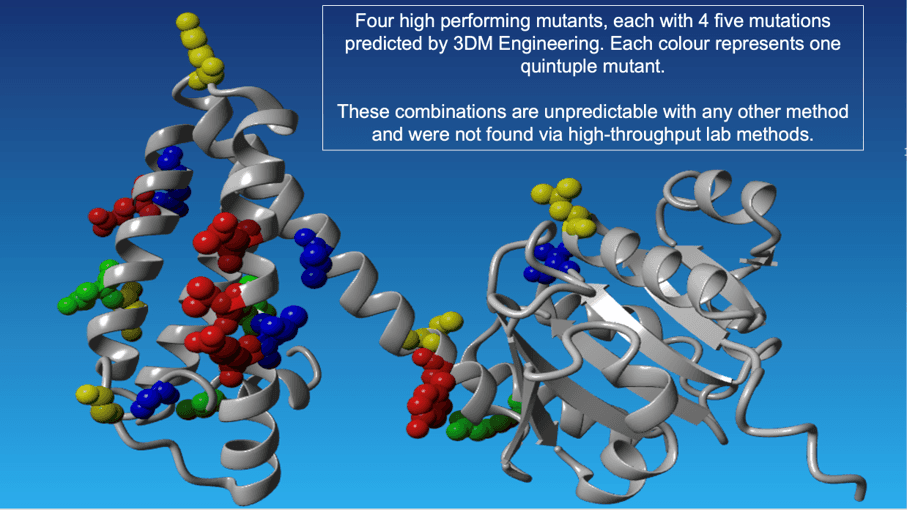
The precision at which the 3DM Engineering AI platform can combine mutations was nicely demonstrated with one large pharma customer. They used state-off-the-art laboratory high-throughput methods to develop an enzyme used for making an important building block for a specific medicine. After 30 rounds of high-throughput lab testing of this enzyme to make it active enough for application, they hit a plateau and could not increase the activity anymore by screening tens of thousands of variants. 3DM Engineering predicted just 46 clones each with 5 combined mutations. 9 out of these 46 variants showed a higher activity than the best performing variant they found in their lab. The fact that 3DM Engineering can outperform even the best automated laboratories in the world shows the massive potential of the 3DM Engineering technology.
All these successes have resulted in securing a significant series A investment. Two large strategic investors are willing to put Bio-Prodict on the international map. The investment will be used to support worldwide commercial expansion and for further enhancement of 3DM’s capabilities.
Henk-Jan smiles when he says: “It is just the start. But it is the start of a dream that becomes reality. A dream I had more than 18 years ago”.


