

Innovation
Choice for Women: Reimagining birth control on Eindhoven's innovation ground
In a groundbreaking move for reproductive health, Eindhoven's Choice for Women has unveiled a new, non-hormonal birth control device.

From left to right: Leonie van de Kamer (Co-Founder & Chief Clinical Affairs), Peter van de Graaf (Co-Founder and CEO) and Peter Vos (Associate Professor Animal Reproduction). Photo by:
The story of contraception spans millennia, from ancient Roman bronze pessaries to Giacomo Casanova's lambskin condoms, culminating in the birth control pill's introduction to the American market in 1960. Yet despite this long history, the field has seen remarkably little innovation in recent decades, leaving women with limited options that often come with significant physical and psychological burdens.
An answer to this call for change is emerging from a place built on a century of Dutch innovation. On the former Philips industrial site of Strijp-S in Eindhoven, where innovation has been fostered for over a century, Choice for Women, a medical technology company founded in 2018, is working to transform reproductive health. Led by founder and CEO Peter van de Graaf, Choice for Women is developing a revolutionary contraceptive device that could transform the way we approach fertility control by addressing the limitations and side effects of traditional methods.
‘’Women have been very disappointed by the existing options. You can see it in the data that sentiment became more and more vocal while we were working on it. The pill is being rejected more and more, not only from a health aspect, but also from a mental health aspect’’, concludes Van de Graaf.
Why did Peter van de Graaf start on this quest? ‘’I wanted to do something useful. I read a lot and travelled a lot. I thought the basis of the problem is that there are too many people. Then I found out how many unwanted children there were. That was the point for me. What would the ideal contraceptive look like if I reimagined it from scratch?’’ Van de Graaf's vision for the ideal contraceptive emerged from asking fundamental questions about reproductive choice. ‘’Then I thought about what the ideal contraception would be. What you would want is very simple: that the sperm and egg cannot come together until you decide otherwise. And this protection is always present until you decide that yourself. And in a way that is always there until you decide something else.’’
A new, safer way
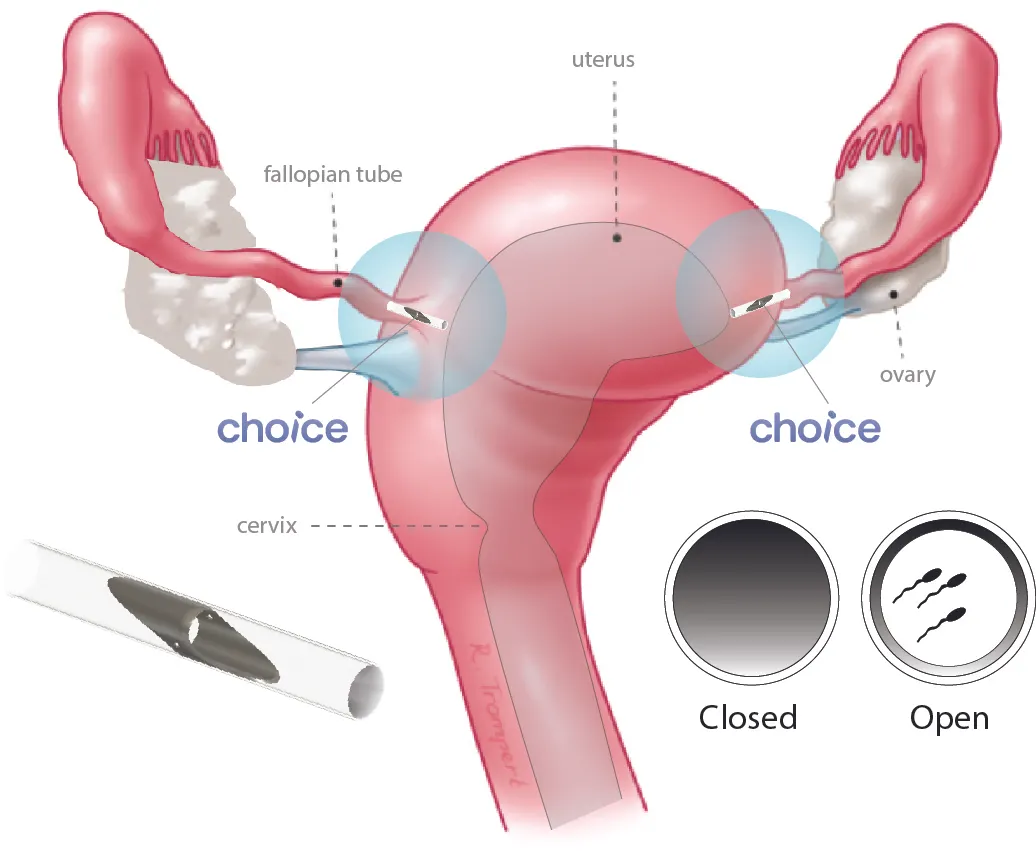
The core innovation of Choice marks a significant departure from existing contraceptive methods. Rather than relying on hormones, the device uses a mechanical approach. To achieve this, the team has developed what Van de Graaf describes as the smallest endoscope in the world, which is part of an insertion tool he compares to an spaghetti strand in size. Using this microscopic camera, a physician can precisely place tiny implants with valve mechanisms inside the fallopian tubes. These bi-stable valves, which are designed not to open or close accidentally, can then be controlled to either block or allow the passage of sperm, all without surgery.
Chief Clinical Affairs Leonie van de Kamer explains the technical sophistication required. ‘’It is bi-stable. It doesn't suddenly return to the other position on its own, so the valve doesn't spring open accidentally. That's part of our 100 percent safety, which we want to offer. We are now almost at the final model.’’ Peter van de Graaf explains the philosophy: ‘’That's why we call it pro-conception. Contraception means you see pregnancy as a threat. But preconception means the opposite, once you decide that it fits in with your life and that you're ready, we're going to try for a baby. Before that, you never have to worry about it.’’
‘’I don’t think there is a single turning point, except that there are a number of social effects’’, he tells about the reason for the criticism on the current options. ‘’For example, we don’t just blindly listen to the doctor anymore. And we have gained a lot of faith in natural and organic living, especially young women. The chemical approach of the pill doesn’t fit in anymore. The IUD presents its own set of problems. Within two and a half years, around a quarter of women have it removed. Firstly, there is the pain experienced during insertion, which is also a significant issue. However, many women continue to experience discomfort, which is not surprising given that it is placed in the lining of the uterus. It's a bit of a mess.’’
One of Choice's most significant advantages lies in what Leonie van de Kamer calls its ‘discipline-free’ nature.
This concept addresses a fundamental weakness in many existing contraceptive methods: their reliance on consistent human behaviour. Van de Graaf draws an analogy with dental hygiene to illustrate this point. ‘’Most people brush their teeth twice a day. Occasionally you have a party and it's become so late that you fall into bed and skip it once. Or think of a moment of transition, such as a divorce or the death of a loved one. You can neglect the pill a bit and suddenly you're pregnant.’’
An unprecedented path to human trials
Choice for Women has adopted a sophisticated, phased approach to bringing its technology to market. The initial version will be operated manually by a physician. However, the ultimate vision incorporates wireless motorised operation, which would give women direct control over their fertility. During the latter phase, the valve could be opened or closed simply by the user wearing a special band around their belly for approximately half an hour.
Leonie van de Kamer explains the technical sophistication required. ‘’You can imagine how small this is and how small the motor must be. The fallopian tube is very small and fragile. You can't have a protruding part with a motor there. Something very small has to be added. That's why we said: 'Can't we launch this in phases?. The motor is the most ideal situation: by means of a band around your belly, the valve closes or opens in half an hour. We are first going to market with a system that has no motor at all.’’
This phased approach reflects the technical challenges of miniaturisation and the practical realities of bringing medical devices to market. Starting with a simpler version and gradually introducing more sophisticated features enables the company to begin helping women while continuing to refine the technology. Peter’s design criteria were clear and comprehensive, as he explains. ‘’So I wanted to have something that was always there so that you don't have to think about it. It had to be free from chemicals to avoid any side effects and be pain-free. We now say hormone-free, pain-free, carefree, and reversible. Carefree also means no discipline. You don't have to do it every night.’’
There are three important aspects that need to be tested. ‘’First, the rabbit test to demonstrate biocompatibility in statistical terms, as calculated by the NIH. Then, together with the UMC Utrecht and the veterinary institute, we have to conduct a measuring test. This involves sperm cells. Open the valve, close the valve and no more sperm cells. Then open the valve and an egg will go through it, all under a microscope. We have to show neither sperm or egg is negatively affected by the valve. Finally, and most importantly, we have already conducted special research with the Máxima Medical Centre.
Specifically, we are the first in the world to have been granted permission by the medical community to place our prototypes in women just before they undergo a hysterectomy.’’
This unique testing methodology takes advantage of a specific clinical situation, as Peter van de Graaf explains. ‘’And that's unique because most organs, you can't just play with them. But an organ which half an hour later is in a metal container, you can do more with it. The approach allows for real-world testing in human tissue while maintaining ethical standards. The partnership with Máxima Medical Centre demonstrates institutional support for the technology's potential. The Board of Directors see the strategic plan of Choice and how good that is for women. And the gynaecologists at the Máxima Medical Centre also recognise this. That's why they've been our constant supporters.’’
More than a device: a social mission
The development of Choice extends far beyond commercial considerations, embracing a broader social mission. Van de Graaf describes the issue of unwanted pregnancies as deeply tragic, and states that the company's main objective is to ensure that every child is wanted. This mission has led to what he calls a 'passion proof’ solution: a device that remains in the body, provides protection and does not require active thought during intimate moments.
The company's founding philosophy reflects this social consciousness. ‘We started the company with the belief that every child should be wanted. Actually, you see that that was my primary motivation.’’ The social consequences of unwanted children extend far beyond individual families. Van de Graaf cites research from the United States showing that the majority of crime is caused by boys who were not wanted at home, who start on the street with petty theft and later become big criminals. ‘’The child gets little chance of a good upbringing, love, food and a good education.’’
This social perspective initially motivated van de Graaf's entry into contraceptive innovation. ‘’It came from concerns about what we are doing to this planet ecologically. Whatever you invent: the number of people remains the same. If you start living twice as ecologically and you get twice as many people, you've ended up at the same point. What you especially want is to reduce the number of unwanted children.’’
The mission's impact extends far beyond the Western world, as Peter van de Graaf powerfully illustrated during a lecture he gave in Egypt. He found himself addressing a room of 250 students, all of whom were women. ‘’The woman next to me clapped her hands. It was marvelous. The whole room was shaking. Interestingly, I wanted to do this because Egypt is a very conservative culture. One girl asked: 'Isn't this haram?'. All the other girls replied: ‘No, it's not’. Then they said: ‘We can help the poor neighbourhoods with Choice’.’’
Challenges in funding
The funding strategy for Choice reflects a combination of practical necessities and philosophical commitments. The company has raised money through a combination of public and private sources, including startup funds, government subsidies, family investment, and private impact investors. ‘’Everyone sees that this is valuable and rises above the normal commercial. On the other hand: it's also a good business case. If it succeeds, we have a product with billions of euros in revenue.’’
The funding journey has revealed systemic challenges within the innovation ecosystem. Peter van de Graaf reflects on the difficulty of securing traditional venture capital. ‘We are becoming increasingly frustrated. We are kept alive by angel investors, by people who believe in us and our mission. But venture capitalists usually say that the development time is too long and the risk is too high. We decided to completely rethink our approach and launch a public campaign to first convince people of the importance of this venture and then ask for their support. We have now collected a substantial sum through this campaign, but need more, so we keep on asking people to go to choice.nu and invest.’’
This article is part of a partnership between BiotechNews and BioPitch. See here for the original article on BioPitch.